Felicia Shakiba (04:30.112)
Everyone's talking about AI transformation, but few leaders know how to make it real. Thibault, Chief Product and Growth Officer of The Brief and former VP at GitHub, Adobe, and Pixart joins us to unpack what it takes to evolve a product and a team into an AI native powerhouse. From building with design,
code and marketing instincts to teaching employees to think like super humans. This episode gives leaders and teams a practical roadmap to become AI super employees with Thibault's top 10 tools for thinking, working and creating faster and smarter. Welcome to the show Thibault.
Thibault (05:48.918)
Hey Felicia, very nice to meet you, thanks for having me.
Felicia Shakiba (05:52.299)
It's a pleasure to have you here. We're excited to learn more about your amazing tools that you have selected or picked from your toolbox as a creative. But Tiibo, before we jump into the tools, you've had one of the most multi-dimensional careers in tech, designer, developer, growth leader, and now chief product officer at The Brief.
So how did the mix of creativity and engineering shape the way that you see the future of AI? And why do you think you are wired to curate the ultimate creative AI toolkit?
Thibault (06:36.174)
Yeah, well, know, it's a good question. If I look back, I think that when I started my career, I started my career as initially as a designer. And because I started as a designer, I went into code because I needed to build websites. for those that remember back then Flash, when Flash was a thing, I learned design and code through Flash that integrated code.
and design together. That's how I learned interaction design, prototyping, animation, and how to make things move and how to actually build experiences on the web. And when I later became, started to get into the kind of like software as a sales engineer or later as a product manager, because I went from design to code,
to sales and then product management. When I arrived as a product manager and later product marketer, that design background and that coding background have helped me tremendously understand how both things are needed to create great products. the thing that I like to tell my, you know, I remember talking to my PMs a while ago that I was, I had my team and I was like, you have to,
feel the pain yourself of the customer for the product that you're building. And so when you're building a product like Debris for any product manager on earth that's building a product, it's always a good thing to have felt the pain yourself. And so for me, working on creativity and AI, I have been a designer, I have been a marketer, and I understand how technology works. And I'm able to have, think, maybe
good instinct and intuition on where the pain is. And given that today the lines are blurred between code and design, and even the roles are being blurred between the designer, a product manager, and a coder, because now people can generate code, I can generate design, the lines are blurred, then I think that the people that have been able to touch these different things, different areas,
Thibault (09:00.056)
can move really fast and can build great products if you understand how the technology works together and if you have strong empathy. I would summarize as it used to be the edge was on technology. And now it's really about how much empathy and how much do you understand the customer problem and how quickly you can build it and get it to market.
Felicia Shakiba (09:22.284)
I couldn't agree with this experience more because I've had this experience, you know, when I had like my first startup back in, I don't know, was 2015, 2017 or something. I had to like learn, I had to force myself to learn design and, you know, learn marketing. And once you truly have that hands-on experience, you have so much more perspective and you can make better decisions. And I just think that with your experience, you're like, just that
Thibault (09:37.663)
Mm-hmm. Yeah.
Felicia Shakiba (09:52.073)
empathy piece, you truly understand what those challenges are. And you can look at making decisions from multiple perspectives. And so I'm just excited to learn more about, you know, what you've selected because you're the ideal person to figure that out. So let's start with maybe just the foundation, you know, what's the one AI tool every creative should master to think and build faster.
Thibault (10:22.562)
Yeah, so I think, you know, maybe for the people listening to us, it might be a surprise or like something evident like duh, of course. But I think that I would say the most important thing is to master conversational AI. And the reason it's not a particular tool, but it's more how to actually use AI to think. I do think that the speed
is not just about the shortcuts or getting to something that you can create. Of course, all of us are using GPT or cloud, whatever you want to use, Gemini to get things done, whether it's rewriting a blog post or getting an artifact out of something that you want to get generated. But personally, the thing that I found has been the most transformative in the way I work has been using AI.
as a way to have cognitive leverage and thinking faster. And so I think that I use conversational AI. personally love using Claude. found it, I find it to be especially, I think GPT-5, they made a decision to simplify and make it more like simpler for everyone when it comes to quality and performance. personally,
I Anthropix models, especially Sonnet 4 or 4.5. And I've used that to converse, share unbaked ideas, ask questions about some thought process to poke at the way I think and understand patterns and actually ask me questions. And I found it to be transformative.
because it has helped me find things that I didn't think about, kind of like being a thought partner. And so for me, also often see people when you use imaging models or video models, all of the models that are in the industry to create content, I see a lot of people still thinking about how do I write a prompt? How do I enhance my prompt? You should be using AI to write your prompts.
Thibault (12:42.238)
We internally at the brief we use AI to generate and maintain an evil or system prompts that Orient the models into thinking a particular way So using AI to think and using AI to generate things to talk to AI I think that's an evergreen I think skill for the future whatever the product or the model is really using AI to think faster
has been for me transformative.
Felicia Shakiba (13:14.583)
So you're saying the conversational AI you're saying is like a touch GPT or perplexity or grok or okay. And, and using them or leveraging them to create the right prompt to then, get your answer back.
Thibault (13:22.316)
Yep. Yes.
Thibault (13:31.308)
Yes. Yes, yes, absolutely. And there is a prompt that I found on actually Danco's Substack where he talks about this prompt that he's been using that he shared to his subscribers. And I have no affiliation and just talking about it because I think it's just a super interesting tool that I've been using. And he shares this.
two-pager prompts that helps him write. And I've been using it. I give it a topic, whatever topic it is. Recently, I've been thinking deeply about vibe marketing. I wanted to kind of like use that as a conversation to have the AI ask me questions so that I can even develop concepts, find my own in my own thoughts, the patterns and even
find also the sometimes the contradiction in what I say. And this prompt sets the model to ask you question as an interviewer. It can go as long as 10, five, 15 an hour. I usually have a conversation for 30 minutes. And then the model is taking me into this kind of like exploration, asking me question, telling me, hey,
You said something about that, but what about that? Because you said earlier, yes, and then sometimes even spot again, contradiction and consistency patterns. And it's been just amazing. then at the end I say, okay, let's now write the article and it will actually generate a first straw man that I then need to basically rewrite and integrate into the way I would speak. But it's so helpful.
to get to something that would probably take me a week of work, but being able to get to a few hours. And I think that is amazing because it's helping me be a superhuman. So I think, yes, great using GPTN and all these tools for generating things, but for thinking, I think it's what's been for me the real aha moment.
Felicia Shakiba (15:52.717)
The real aha moment. Yeah. I agree. think I've done it both ways. mean, I when I started using conversational generative AI, as we all might have, it was just, what is the answer to this question that I have? I think thinking about how to ask the question, what to make generative AI? Are you a professor? Are you a researcher, et cetera? And then
you know, being able to go back with feedback and really poke at the, you know, provoke great responses, I think is kind of what I'm thinking that you're getting at. Yeah.
Thibault (16:31.052)
Yes, yes, exactly.
Felicia Shakiba (16:33.101)
So you started your career as a designer. What's your go-to AI tool right now for visual creation or concepting ideas?
Thibault (16:43.278)
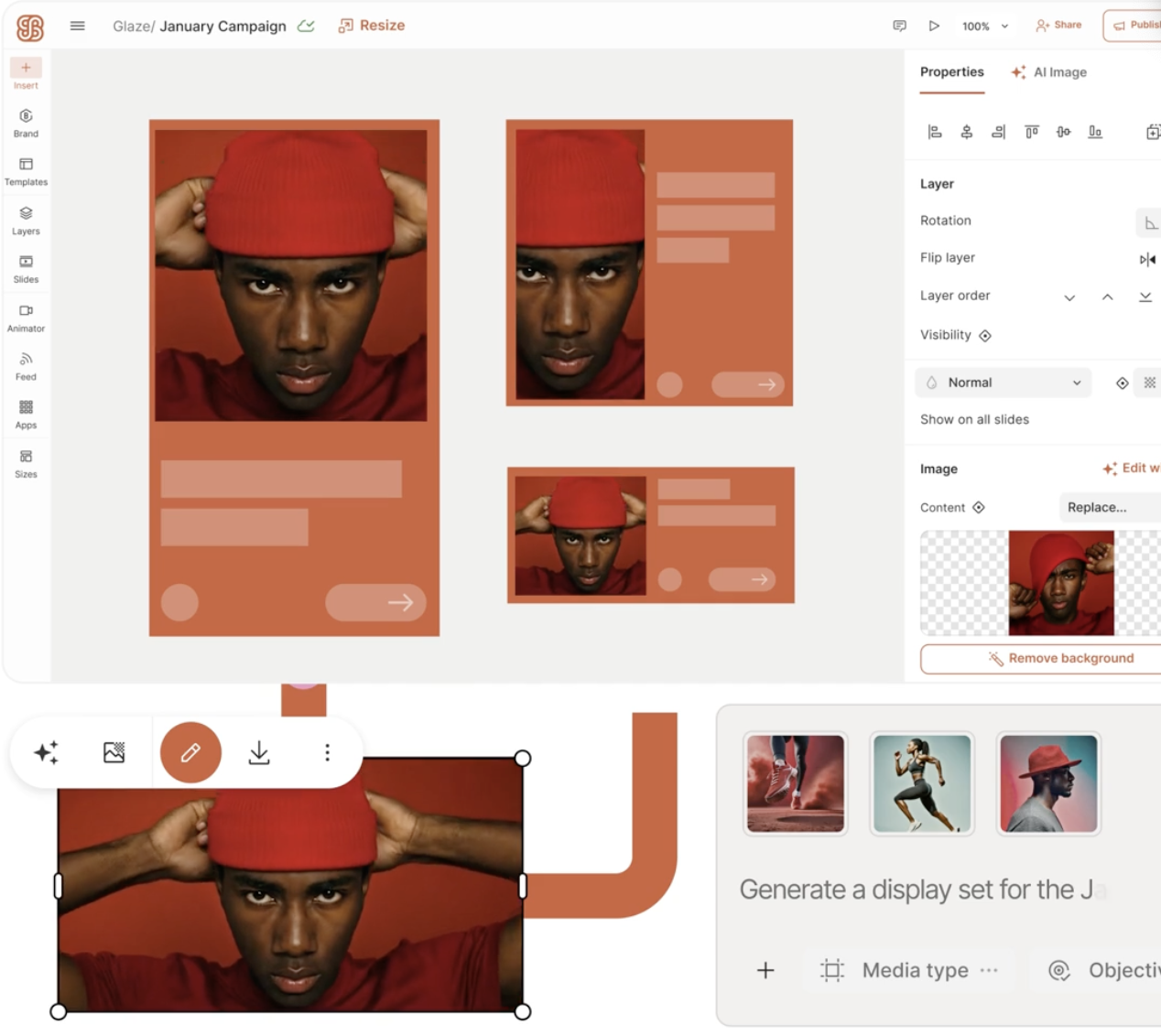
Yeah, so I it's hard for me to So I have bias because we've been building a tool right now That's called mood boards in the brief that I love To help it's kind of like an infinite canvas for vibe marketing And it's it's powered by different models. I think Google Nano banana model, Jimmy night 2.5 flash
is quite incredible at its capabilities. So people have used these models to generate images, but when you put it into a mood board where you can actually just throw things and arrange, you know, like some people have used Pinterest as a mood board and so on, but imagine a mood board that's interactive where you can just put all kinds of things and then you can say, I want to generate
an ad or a flyer or like even take these clothes like those shoes and that cap and that dog and let's put that into a scene and let's have someone wear these clothes next to the dog and in the street. It's just, I'm blown away by this idea of vibe marketing and being able to just design at the speed of thought.
And so we have built this mood boarding feature powered by these different models. And I think for me, I could spend hours just thinking. And for the first time, I don't know about you, but personally, I come from a design background. And the thing that's very interesting with Vibe marketing is that the reason why I think it's transformative
is because for the first time, I think, in the history of design and marketing for people that create content, historically, the people that were deemed creative were only the people that had the technical skills to express their creativity. So, you know, it's only the person that knew Photoshop or Figma or Canva that could say, that person is so creative.
Thibault (18:59.882)
Any human is creative. People are creative by, know, I think we all have some level of creativity. Some people don't even think they're creative. Maybe they express it differently. But for the first time, you can just express in natural language something you want to create. And everyone can be part of the conversation about creativity. Everyone has a voice. And I think that's just really a beautiful thing.
Felicia Shakiba (19:25.175)
So my first reaction is, there's a tool that does that? Because where have I been?
Thibault (19:30.114)
Yes, yes. Yes, there's a tool that does that. And yeah, so in the brief, there's a mood board feature that we have that does that. It was interesting to see actually Google release something I think called Mixboard the same week. And we were kind of honestly on honor because it's like very, very similar. But.
What we did is that for our mood board, it's integrated with the rest of the platform where you can do all kinds of things related to your marketing, not just vibe, vibing. But yes, there are tools like this. I encourage your audience to check them out because it allows a room of folks to just jam so quickly on concepts. you know, in the past, like you had to like...
go with a brief and then get that into the hand of the creative team and they create concepts and they come back and then you review and then someone's like, I'm not so sure, maybe this and then it would take weeks of back. I mean, you know, you've created content, you've made it, you know that stuff, you've probably even done it yourself. Yeah, yeah, we'll have another round. And then, but now everyone can just be like, no, let me just change that. Ooh, look at this, yes. And then.
Felicia Shakiba (20:38.957)
We'll have another round next week, you know, for...
Thibault (20:52.942)
And then very quickly, just like our previous point about thinking, now it's doing, I was telling my CEO recently, like 70, know, people used to start at zero or maybe at 10 because you have a template or something. Now people start at 70%, right? Like, so 70 is the new zero. And you can now spend all the energy that you have saved on the zero to 70 because you're already at 70%. All of that time, you can reallocate it for
other things. That's pretty awesome.
Felicia Shakiba (21:26.493)
Absolutely. Absolutely. Okay. Wow. So that's really exciting. I think of it as action oriented, like in real time, creative feedback. That's the way I'm thinking about it. Yeah. Which is brilliant. That's exciting. How long does it like actually take, you let's say you bring, you know, the first concept, you know, how hard is it to change?
Thibault (21:40.406)
Yeah, yes, yeah, yes, yeah.
Felicia Shakiba (21:56.691)
the next concept? Does it actually, when you say, instead of a blue hat, I want a pink hat, and does the pink hat land somewhere else? Or is it actually accurate as to where you want that pink hat to be?
Thibault (22:05.9)
Yeah.
Thibault (22:12.526)
So the models now are especially the latest models that have been released, whether from Google or Black Forest. One is Flux.1 context. The other one is Gemini. And I'm mentioning the names so folks understand which models we're talking about here. Those engines are really, really good at prompt adherence and context. A year ago, a lot of these models
would change, not respect. Let's say you would have a woman and you want to add a hat to that woman. It would invent new hair or change the face of the person while it's adding other things. Now, these models are really good at preserving the context and only changing the things you want and actually putting them exactly where you want them. So what's amazing, it's really almost as fast as you can think. So if you say,
let's have that woman wear a blue hat instead of a pink, it will probably take just maybe like five, six seconds to do it instead of, you know, let's say you have a creative team, it would take probably a few hours or if you were in Photoshop and you had all the settings, maybe it would take you five minutes. But now anyone can just say that and have it almost instantly.
Felicia Shakiba (23:36.865)
Yeah. Okay. And so that's very interesting. I mean, I think that I would use that tool. You've also talked about, I know, and now I'm like really excited. I want to go try it. You've talked about turning voice into creative output. And I think this is a really interesting piece because voice is becoming, I think, more popular. What's the tool that changed how you communicate or ideate?
Thibault (23:44.353)
you
Thibault (24:05.73)
Yeah, so there's two tools here. I'm gonna cheat. There's two that I think are really interesting. So the first one is related to voice is Whisperflow that I've been using. And it's more about the communication rather than the ideation. Whisperflow is a tool I discovered a few months ago. It is a...
voice dictation app using AI. And it is available also on, I think on mobile. I use it mostly on desktop. And it's integrated in it. It integrates at the OS level. So automatically you can use it inside Slack or whatever you use. And what's awesome is that it is doing voice recording, speech to text.
in a way that's very sophisticated in a sense that it's, if I pause, if I, mm, if I think and I come back, it will interpret and actually synthesize what I'm saying. And it will also help people that don't necessarily speak good English or other languages to basically express themselves in a way that feels very professional, but also not,
inconsistent with their tone. So it's really a phenomenal tool that I encourage people to try. I use it all the time to respond on email or Slack and it's helping me save a ton of time. It's so bad that now I will admit I'm getting bad at typing.
Felicia Shakiba (25:52.349)
Are you bad at spelling now?
Thibault (25:54.821)
I'm because I'm like, it's just so much faster to speak and have the robots do the work. So now sometimes I'm typing, I'm like, oh my God, I'm getting rusty. So I need to maybe pause a little bit, but it is an amazing tool. So that's what I've been using for helping me be succinct with my communication and save a ton of time.
The other tool that I've been really impressed with, and this is a little bit more advanced, you need to do a little bit more work, is 11 Labs. That's a service to help you basically generate, record your voice. And I've been thinking about, so you can basically record your own voice and then use it for marketing.
So it's been really interesting. I've been experimenting with it for my own kind of side hobbies. I have an Instagram about music, and I used to do all that stuff very manually. I used to create all the videos, all the editing. I've generated thousands of videos, maybe not thousands, but yes, close to a thousand videos manually from my phone. And now I generate...
I give it a prompt and then I have the agent go research, create the content, assemble all the assets and I do very little editing. And then I was thinking about the narration. I could record with 11 labs my own speech. So it takes like, you can record five to 10 minutes, ideally 30 minutes. And then from there, they have a voice, kind of like a print.
of your voice and you can generate podcasts, can generate episodes and then you can basically go from text to voice. And we're all busy, I have a family and so being in front of computer, recording all these things, I can just generate in one shot from my text, my voice perfectly without pauses or anything. So that's another amazing tool that we...
Thibault (28:14.862)
that we've also looked into integrating into the brief for marketing. So Whisper Flow and then 11 Labs.
Felicia Shakiba (28:23.853)
11 labs. I got to get on all of these tools immediately after this call.
Thibault (28:27.5)
You could have Felicia 11 Labs model and then you could create some additional content with that.
Felicia Shakiba (28:39.329)
I think I'm going to experiment and then I'm going to send you what I made because I just, I'm going to show you what I did and see if it, you know, is up to snuff with. Yeah. Probably not, but we'll see how, which actually brings me to my next question. Because when you're moving from idea to actual product, what is your favorite AI tool for prototyping or building in real time?
Thibault (28:45.783)
Yeah.
Yes.
Thibault (29:05.902)
Yeah, so I have been using Cursor myself, which is a tool, an editor, code editor, built by a company called, I think, Codesphere, I think, if I recall. And Cursor is essentially a version of Visual Studio. So Visual Studio being a code editor that's maintained by Microsoft.
It runs on Mac and all that. But the company created an improved version of Visual Studio called Cursor. That's AI first. And I've been blown away by the level of productivity that I am a former coder. So I have some familiarity with obviously code editors and all that. used to program a lot.
But now, interestingly, Felicia, as a PM, and I posted on LinkedIn the other day, it was interesting to have conversation with practitioners. For the first time in my history as a PM, I've been a PM for 15 plus years, I have been able to ship my own features in products that I PM. And this is something that I used to code. And since I transitioned from developer to PM,
in 2008 or 10, I never, at 2010, I never contributed any line of code to my products. And now with Cursor, I'm able to vibe code some things, to have Cursor tell me where the code is for something. And actually, once I have some kind of code that's generated, I can actually review the code, integrate it and...
rewrite some areas that I think might be missing a little bit of correctness. But in some cases, it's actually entirely correct. And I've been able to go from ideas that I would show to the team as prototypes in a few hours to actually shipping code in production in a few hours. And I was like, wow, this is how I think companies, AI.
Thibault (31:29.514)
native employees can help companies move so much faster. So cursor for me has been amazing. And I think companies that adopt AI native workflows and AI native employees and help their employees become AI native will win because I today between the tools we just mentioned, I do the work of maybe two or three T-Bows in a day before AI.
Felicia Shakiba (32:00.205)
Yeah. I mean, I could always use a few more Felicia's on my team as well. I mean, I actually do. So the way that I use generative AI is if I need advice or feedback, which I'm, I'm very like a collaborative person and I will, you know, create my own, um, chief, you know, chief, whatever officer. And I'll say, I'll say collaborate with me on this right now that, know, this is who you are.
Thibault (32:06.146)
Yeah.
Thibault (32:17.272)
Mm-hmm.
Felicia Shakiba (32:30.343)
And you specialize in X, Y, and Z. And you know, what do you think about this? What do you think about that? And so, yeah, I mean, you can create versions of yourself and with the amount of speed that you're moving with those tools. I mean, in addition to what you had said earlier, which was 70 % is the new, it was where you started zero, right? Yeah, it's definitely super human-like, I would say. But...
Thibault (32:51.842)
Yeah. Yeah. Yeah.
Thibault (32:58.082)
Yes.
Felicia Shakiba (32:58.953)
If you could recommend one creative superpower tool that everyone should try today, the one that still surprises you, what would it be and why?
Thibault (33:11.47)
So the one that I have, so someone told me about this a while back and then more recently I started playing again with is Notebook LM. So Notebook, have you tried it? Yeah, so it's a research, is a, Google is really back into the,
Felicia Shakiba (33:23.329)
No, son.
No, what is this like exciting surprise?
Thibault (33:38.742)
It's kind of amazing to see Google really. For a period of time, people were saying, like when there was GPT in Google, Gemini was still not a thing. And then even in the AI models with Gemini 2.5 Flash, I think Google is back big time. VO3, their video model, so it's quite amazing. But the point I was trying to make is around Notebook Alarm is a product, is a project from Google. And given of the...
given the DeepMind history, they have so many really interesting research projects. And Notebook LM is a product that allows you to upload all of the content that you want to upload about a particular topic. So it's heavily used by students, researchers, and other practitioners for basically
studying a particular topic. an example, you can upload, I've seen that one of the lead on my team, my last company did that and I was blown away. You can upload customer research. So imagine every company has a lot of content about their customers in terms of customer research, interviews and most of the time, these things sit in decks, recording, Zoom calls.
decks and PDFs and dovetail pages and people leave companies and people leave with their knowledge and a lot of that stuff is not really easily accessible self-serve. So what notebook LM for instance you could do, you can upload all of that stuff, you can upload audio recordings, you can upload YouTube videos, you can upload videos, you can upload web, like basically PDFs of all that, anything.
Felicia Shakiba (35:30.036)
anything.
Thibault (35:32.398)
And you will say, okay, this is the customer research. Generate for me a mind map of what you know from my customers. And it will generate a mind map of, okay, here's your customers and per customer type, here's all of the insights. And then you can actually click on a branch and let's say it says, okay, your audience is, let's say you're going after that persona.
What do we know about that persona? And it will kind of extract, and you can actually navigate into your data with the AI doing the work of, again, finding the patterns, finding the key insights, the connection between things. So that's amazing. And then you can basically turn that into a kind of like a GPT self-serve augmented GPT for your customers. So you hire someone on your team and they have a question about,
I don't know, like social, like the customers about a particular audience, you can just ask. And then the Notebook Alan will basically tell you, yeah, you have that problem with customers. In the past two years, here's all the customers that have had that issue. Here's the key things. Here's why you lost deals. But recently, so it's kind of amazing. Another thing that, yeah, it is awesome.
Felicia Shakiba (36:55.585)
It's basically a focus group at your fingertips. Is that what you're saying? Yeah.
Thibault (36:58.828)
Yeah, yeah, and unlike a GPT that you would need to do a lot of the manual work to say generate these types of artifacts, I don't think GPT would be great at that. I think probably Cloud would be better, but Notebook is thought for outputting that content into artifacts that you're going to be able to use to present or listen. For instance, when it comes to we're talking about the voice.
One thing that Notebook and Arm can do, and that was honestly a moment where I was just like probably one of the biggest aha moment or more like WTH moment of my AI life. You can, you for instance, you or anyone that's interested in a topic, you could upload the same content and say, generate a podcast.
about that topic. And it will essentially generate a conversation between the number of people that you want to have in the podcast. And it will have the people discuss the content that you wanted them to discuss and reveal the interesting patterns, the contradiction, again, what AI is great at. And so you're listening to a conversation.
about a topic and you literally have these people debating things and bouncing off each other over particular topic that helps you understand how a topic can be approached, the questions people might have and all that. That was, that's just incredible.
Felicia Shakiba (38:41.889)
How long does it take you to put something like that together?
Thibault (38:45.646)
Well, mean, if you probably, mean, the most important thing is honestly having the content. And then once you have the content, orienting the LLM into what you want it to kind of like focus on, but it probably is gonna take you like a few minutes.
Felicia Shakiba (39:07.469)
Okay, just I want to just be clear that all of my guests are real humans. Okay.
Thibault (39:13.482)
Yes, I know we are humans. We are humans and I do think yes and yes and yeah.
Felicia Shakiba (39:19.319)
I am a real human. am on this podcast. Go to YouTube if you're not watching and if you're only listening, go to YouTube. We are actual real people, but go on. Yes.
Thibault (39:29.622)
And one thing that I've seen people do, which I thought was really cool, is using Notebook LM, though that I think you could do potentially with a GPT, is having Notebook LM just output the text in a slide format that you can, or just like in a presentation mode. And you can just pass that to Gamma, which is another tool that I wanted to mention, where Gamma, which is a...
AI presentation tool will take that text and create the entire presentation for you. So that could help you again, get to the 70%. It's not like, and I'm telling my son to not use these things to just produce and repeat, you know, without using that to think, but to extract things, put that into a presentation and actually look at this, review it yourself and use that to actually
work on it to share. Again, it's amazing in terms of the time. It's going to save you. And that presentation that it's going to generate can be reused, tweaked, and you're saving a ton of time. So Notebook LLM, amazing. I would encourage everyone to check it out. I believe it's free. And yeah, connected with Gamma for getting that into presentation to extract the insights.
Felicia Shakiba (40:56.663)
So I've always been a little wary of presentations because I would say I'm like a little bit of a stickler when it comes to presentations because I like my colors and I like my, you know, everything to flow nicely and I'm very visual. So I guess I'm curious to understand how well of a presentation that it makes, but I guess it's a really great start, right?
Thibault (41:21.23)
Exactly. mean, you know, just like any presentation tool, I don't think presentation tool, think I've also like you, I've struggled with them for different reasons, but it gets you 70%, 80 % there. From there, the time you've saved in creating all these things, these icons, like illustration and all that, that's...
Felicia Shakiba (41:40.727)
Yeah.
Thibault (41:50.274)
all that time that's now is back, you can use it to actually customize and actually make it really nice. And maybe you wouldn't have actually had had the time to do that because you would have spent a lot of that time in the busy work of just creating DAGs, duplicating and replacing things manually. And you can just have the AI do that for you.
Felicia Shakiba (42:11.905)
Yeah. Thibaut from France, sitting in France all the way across the oceans. Thank you for being with us today. This has been so awesome. I'm so excited to try all these new tools out and you've given great value to our listeners. So thank you for being here and yeah, I think we're going to have you again at some point.
Thibault (42:16.462)
you
Thibault (42:23.352)
Yes.
Thibault (42:33.174)
My pleasure.
Thibault (42:37.206)
Yeah, I would love that. And you'll probably have used some of these tools and we can do a V2 of how these tools work. And it's moving so fast, so probably in a week there would be new things we could talk about.
Felicia Shakiba (42:51.933)
yeah, I can't wait for that. Thanks for being here. Bye. Okay. I'm going to just stop.
Thibault (42:56.206)
Thank you. Bye.